
“>
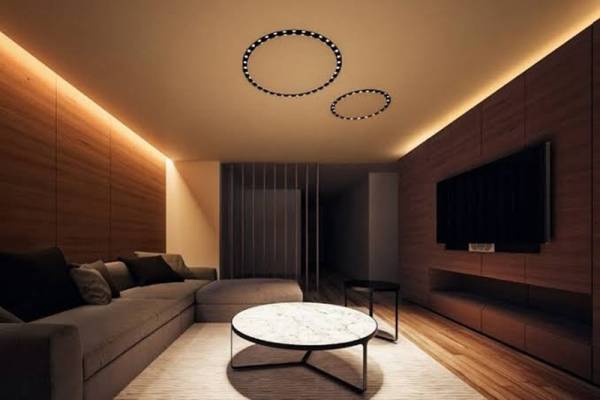
The ceiling has ceased to be the “default white plane.” In interior designs for 2026, it functions as a complete design element: it sets the lighting scenario, accentuates the room’s geometry, and even replaces some light fixtures. Let’s explore what’s currently trending and its associated costs.
A Matte Ceiling as the New Classic
Gloss, once a symbol of “Euro-renovation” a decade ago, has largely exited the stage. Matte finishes dominate designers’ projects—they resemble a perfectly flat painted ceiling and do not create glare. This is the most versatile and, at the same time, the most affordable solution; in budget calculations, a matte ceiling is taken as the baseline.
Shadow and Floating Profiles
The second stable trend is the rejection of visible transitions between the ceiling and the wall. A shadow profile creates a uniform “shadow” of a few millimeters around the perimeter, while a floating profile provides a soft backlight line that visually separates the ceiling from the walls, adding height to the room. Both solutions work particularly well in minimalist interiors devoid of cornices and baseboards.
Light Lines Instead of a Chandelier
LED lines embedded into the canvas create graphics on the ceiling: from a strict stripe above a kitchen island to complex compositions in a living room. Along with magnetic tracks, they are increasingly replacing central lighting entirely. The advantage is not only aesthetic: light is distributed more evenly, and multiple lighting scenarios can be configured—from task lighting to evening ambiance.
Hidden Cornice
A niche for curtains, concealed behind the canvas, is a detail that makes an interior look “expensive” without significant expenditure. Curtains appear to emerge directly from the ceiling, with the curtain rod completely invisible. The niche must be planned during the ceiling installation phase, so it’s worth considering in advance.
What’s the Cost?
The budget depends on the type of canvas, profile, and lighting. Approximately: a basic matte ceiling represents the lower end of the range; a shadow profile adds to the perimeter cost; light lines are calculated per linear meter. Current figures for Kyiv, with cost breakdowns by area, can be found in the open price lists of installation companies—for example, the cost of a stretch ceiling with installation in various configurations. When comparing offers, pay attention to whether installation, profile, and provisions for light fixtures are included in the price—a “price per square meter” without these details is meaningless.
Conclusion
The ceiling of 2026 is about light, clean geometry, and the absence of unnecessary details. The good news is that most trendy solutions are not about a large budget but about smart planning: the key is to incorporate them into the project before installation begins.